A sample of relevant work: website design, and facilitation and consultancy.
Website design
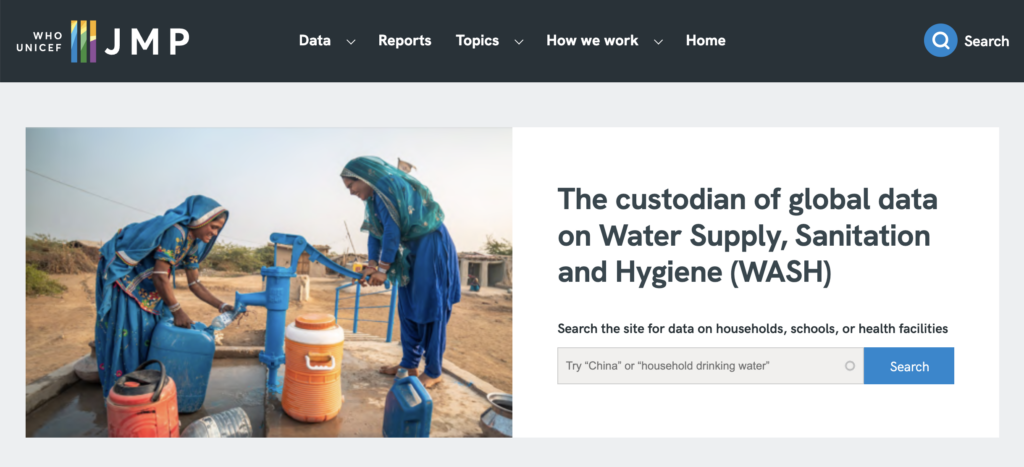
UNICEF/WHO Joint Monitoring Programme
washdata.org
User research, UX and brand for the global reference point on water, sanitation and hygiene data. Delivered at Agile Collective, in partnership with Outlandish. 2018-present.
The challenge. The JMP is the official source the world uses to track progress on water, sanitation and hygiene, thousands of datasets, updated each year, relied on by governments, researchers and policy teams around the world. It is aimed at specialists but has two distinct use cases: anaylyst who wanted to download raw data and interrogate it themselves, and a much larger group who needed help understanding what the database held and ready-made graphics that help explain the data, and help them explain it to others. And it served two separate teams at UNICEF and the WHO.
What I owned. User research, interface design, the user journeys through the data, and the platform visual branding. I ran interviews with users around the world to understand how the data was actually used, then turned that into the design direction. I worked closely with the designer handling the data visualisations, and owned the journey by which someone finds, understands, and leaves with the data or visualisations that they need.
What we made. Interfaces that let a newcomer make sense of the database and a specialist get straight to the download, without either getting in the other’s way. I designed an annual upload process simple enough for the client team to run unaided, with validation built in, working with the technical team to make it hold up against the sheer volume of files. And I built the brand from their own work, taking the service “ladder” they use in their charts as the basis for the logo and visual identity.
Where it stands. The site has gone to ever greater impact, with 2 million events counted in 2025, whilst the editorial overhead has remained substantially lower than before the development. I was appointed to be the site’s Account Manager, stewarding the product as we added two new data sets (schools and healthcare facilities) and we are now preparing for an overhaul, with an AI API layer coming, and identifying how the the site can be more impactful for policymakers in times of reduced funding.
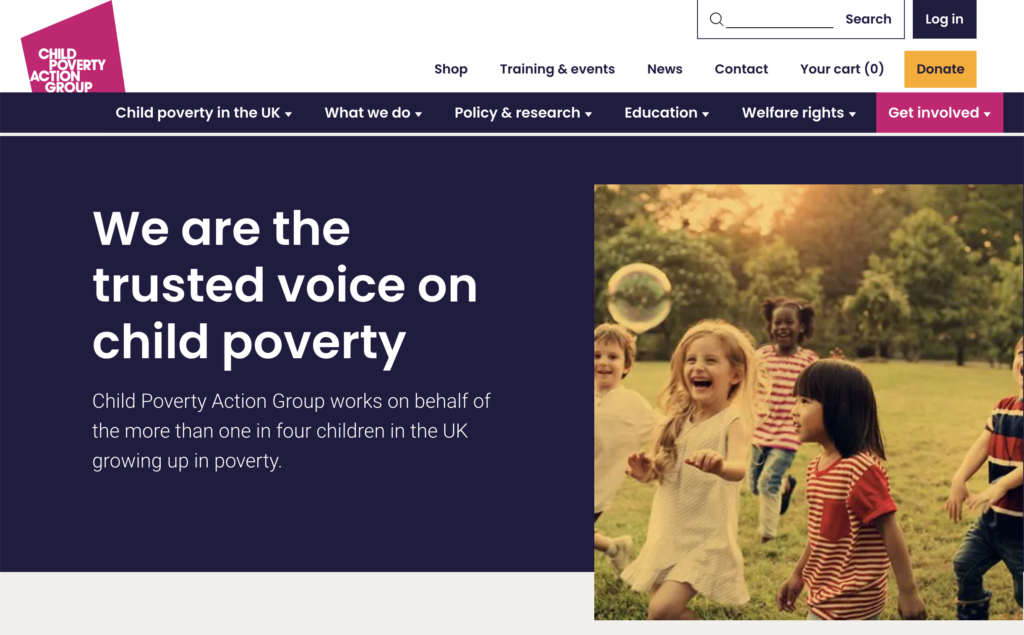
Child Poverty Action Group
cpag.org.uk
Discovery, information architecture and UX for the long-term redevelopment of the UK’s leading child-poverty charity. Ongoing since 2024.
The problem. CPAG came to us looking for a long-term digital partner. Their scope is typically broad for organisations that both raise awareness and act as professional support to their members: they train and equip social workers and welfare specialists, run a research arm, campaign on child poverty, and act as the national reference for the public, the media and policymakers. One website had to serve all of those audiences at once, on a fixed budget but with great uncertainty in the scope.
What I owned. I helped shape the engagement from the first conversations, and designed a 200-hour standalone discovery phase to understand the problem before anyone committed to a build. I oversaw the user research, conducted the Google Analytics review myself, and scoped a rebuild on the latest Drupal. With heavy technical complexity and a fixed budget, one of the greatest challenges was prioritisation: I ran workshops with the client, pulled technical briefs from our developers, and worked through the options for improving the user journeys against what the budget would actually allow.
Across the build, I was responsible for the User Experience work, the Information Architecture, all the wireframing, and the prototypes, including a later phase bringing their publications in-house from a third-party system, which we tested with users. I worked with an SEO specialist on key messaging and advised on the scope of the visual and brand changes.
The impact. It landed immediately. The back end became faster and clearer for their team to run, and the home page finally told their story, who they are and what they do, in a way the old site never managed. They’ve stayed with us, and I’m brought back in a UX capacity every few months as their needs change.
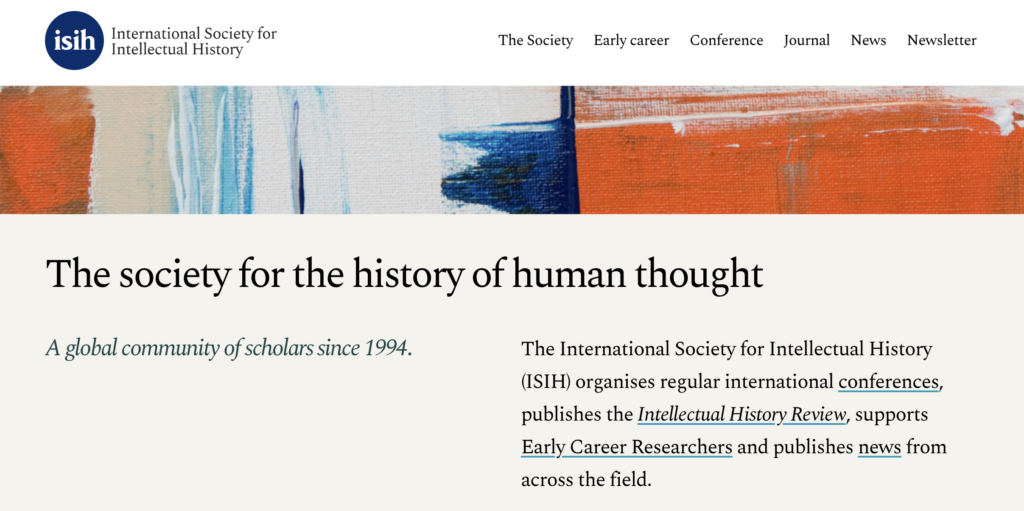
International Society for Intellectual History
is-ih.com
A complete rebuild (brand, design and build) for an international academic society. Independent freelance project, 2025.
The problem. A small international society with a dated website, a tired identity, and more content than it needed, wanting something better-looking and easier to run, on a modest budget.
What I did. I surveyed their members to understand what the society actually needed from the site, then wireframed a leaner structure around what came back. I designed a new identity, including a logo to replace the old one, and set the art direction and a light style guide, a pastel palette built around abstract artwork. I built the site in WordPress, sorted the hosting, designed every page myself, migrated their content, and left them something they could run and extend without me. On time, on budget.
Why it’s here. It’s the smallest project here, but it demonstrates me working wholly alone, which I have done on smaller projects since I ran my own company in the late 2000s.
Other selected website projects
Public sector, international and social policy
- Oxfam International (UX and user research)
- ActionAid International (UX and user research)
- War on Want (UX and user research)
- Freedom from Torture (UX and user research)
- LocalGov Drupal Microsites (DLUHC) (UX)
- Co-operatives UK (UX and user research)
- US Forest Service: Discover the Forest (UX and user research)
- BASW (British Association of Social Workers) (Project Management)
- BISA (British International Studies Association) (UX, UI design)
Universities and academic
- Balliol College, Oxford (UX, UI design)
- Department of Biochemistry, Oxford (Rebrand)
- Clay Mathematics Institute (Rebrand)
- Numerous Oxford and Cambridge colleges and research projects (UX, UI)
Facilitation and consultancy
Agile Collective internal governance restructure
Leading a year-long transition to delegated, consent-based governance at the design cooperative I co-founded. 2025.
The challenge. We had adopted sociocracy (a consent-based model many cooperatives use to govern without line managers) but only halfway. We still ran on the consensus habits that had been fit for us when we were a startup, so every proposal drifted back to the centre and got decided centrally, with no established strategy behind it. Our strategic groups had quietly turned into departments rather than spaces for thinking. Everyone sat in too many of them, overwhelmed by day-to-day questions, while almost no strategy was happening at the heart of the company.
What I did. I went back into the principles and practices of sociocracy, worked out what we’d been doing well and what less well, and led the design of a new structure: an anchor circle accountable to the members, coordinating a delivery circle for our client-facing work and an operations circle for the back office, with the day-to-day work pushed down into teams, such as finance, support, projects. Then I facilitated a nine-month transition that asked people to give up consensus for genuinely delegated authority, and to start anticipating the questions coming rather than just answering the ones in front of them.
The outcome. It held, and on formal review we committed fully to it. People got time back for their actual work, and for the first time strategy had somewhere to live, leading to a rush of strategy: for instance, five-year planning, proper business-development reporting, and an AI sub-circle working through the ethics and sustainability of AI deliberately rather than by accident.
What I took from it. Designing a new structure was relatively straightforward. The transition was the real work, moving from “decide it when it lands on us” to “anticipate and delegate” highlighted every lack of policy and the difficulty of genuine consent in such environments. The learnings form this project meant that the following, a Delivery Playbook (one of the identified strategic gaps) had a much more rigorous roll-out plan in place before we embarked on it.
British International Studies Association (BISA)
A week-long, in-person design sprint for a learned society that wasn’t sure what it needed. Design lead, as part of Agile Collective.
The challenge. BISA came to us to help improve their web presence. The real issue, once we dug in, was structural: their finances rely almost entirely on membership, and people mostly become members in order to attend the annual conference.
What I ran. A full week-long Design Sprint, in person: framing the problem, diverging widely, converging on one direction, building a prototype, and testing it with real users inside the week. As design lead I took them from lack of clarity of where to put most energy to a tested, compelling proposition for joining and attending the conference, carried by a more dynamic website.
The outcome. Conference sign-ups rose, and with them the memberships. Another ide surfaced in the Sprint that the client later acted on: we explored other ways for them to earn, and developed a second, online conference aimed at the Global South, opening the organisation to people who could never travel to the in-person event.
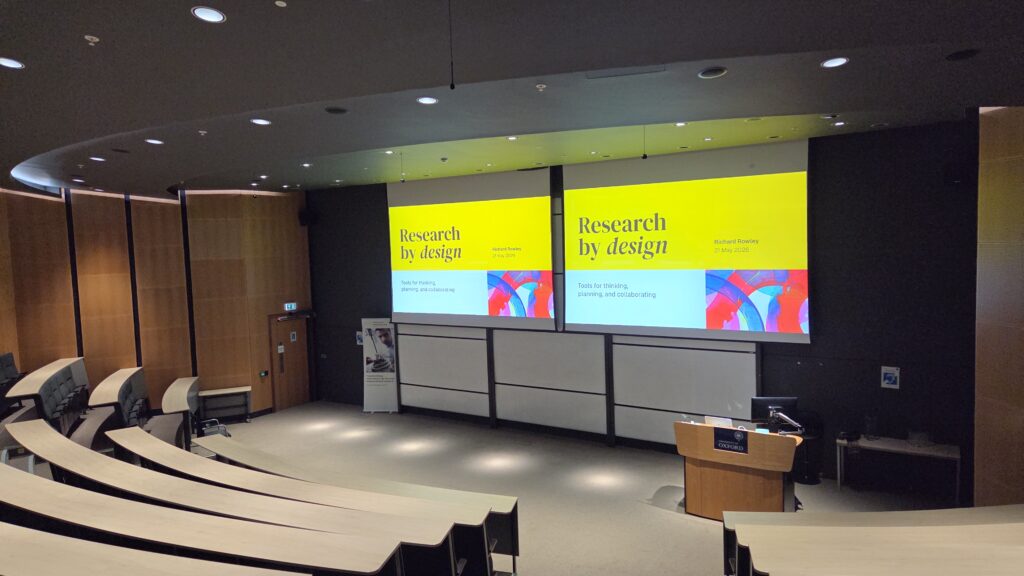
Future Metrology Hub
Two design-thinking workshops in a day, for postgraduate researchers across Oxford, Southampton, Belfast and Huddersfield. May 2026.
The brief. The Hub brought me into its annual conference to run a day of professional development for early-career researchers in metrology (a broad field spanning engineering and physics). The focus was how to navigate the uncertainty of a research career and how to maximise the opportunities of that stage without feeling overwhelmed. We agreed in advance to build the day on design thinking: Stanford’s Designing Your Life approach in the morning, and the afternoon on framing project problems and developing solutions effectively.
What I ran. A morning on designing a research career, and an afternoon on design thinking itself. I helped them treat their careers as something to be designed rather than dictated, understanding their own motivations, and identifying small actions to move forward with the following week in forming new connections or bringing in more of what drove them to this subject in teh first place. In the afternoon I taught methodology and practice: how to identify and reframe a problem (“how might we…”), the double diamond as a discipline for exploring widely before narrowing, how to prioritise, and how a group can make decisions that are both creative and aligned.
What came out of it. The group expanded on alternative paths, how to bring aspects of their ‘dream career’ into their working lives (photography in one case, crypto in another), and, above all, working out how to find and build better opportunities to collaborate, something they previously reported as a challenge.